
Cancellation
The event cannot go ahead at all, for example because the venue is damaged by fire or flood before the date, or the authorities will not allow it to run.
EVENT INSURANCE
Cover for the money you have committed to an event if it is cancelled, abandoned, postponed or moved for a reason outside your control. Here is how the cover is built, what it leaves out, and what sets the premium.
Premiums and outcomes described are specific to this client and indicative only. Your own terms will depend on your circumstances and the insurer.
THE SHORT ANSWER
What is event cancellation insurance?
Event cancellation insurance covers the money you lose if your event is cancelled, abandoned, postponed or relocated for a reason outside your control, such as the venue being damaged, the authorities stopping the event, or severe weather where that cover is added. You insure either your costs and expenses (the more common choice, in our events specialist's experience) or your gross revenue, which adds the profit you expected. The premium is set against the sum insured and depends on the event, the site, the extensions you add and the claims history. Poor ticket sales, lack of support and, generally, communicable disease are excluded.
Cancellation rates vary widely from event to event, so we do not publish indicative figures. Send us the event details and we will take it to specialist event markets and come back to you with the options available.

Our events specialist
Shaneel Gounden
Account Executive
In our events specialist's experience, most organisers insure their costs and expenses rather than gross revenue, because cancellation premiums are significant. Larger or higher-value events are the ones that tend to insure gross revenue.
Previously in the Entertainment and Sports team at Marsh, placing event liability, cancellation and prize cover, then in events at Aon.
General information only. It does not take into account your objectives, financial situation or needs. Consider the relevant PDS and TMD before deciding, and cover is subject to the policy terms.
The event cannot go ahead at all, for example because the venue is damaged by fire or flood before the date, or the authorities will not allow it to run.
The event starts but has to be stopped part way through, such as a storm arriving mid-afternoon or a safety direction from police.
The event is moved to a later date. Cover typically responds to the extra costs of rescheduling rather than the whole budget.
The event goes ahead somewhere else because the original venue cannot be used. The extra cost of moving is the loss.
The base cover, where the venue cannot be used because of fire, flood or similar damage, is broadly similar across insurers. What changes between them is what else is included, what is sold as an extra, and what is excluded outright. Some wordings also cover reasonable costs you spend to reduce a loss, such as moving to a backup venue, up to the amount of loss avoided.
| Basis | What it covers | Trade-off | Usually chosen by |
|---|---|---|---|
| Costs and expenses (budget) | Your irrecoverable costs: venue, production, artist fees, marketing, staffing | The more common choice in our events specialist's experience, because the premium is lower | Smaller and mid-size events, community and association events |
| Gross revenue | Costs and expenses plus the profit you expected to make | Needs evidence of revenue, often prior years' figures | Larger or higher-value events with a ticketing history |
Watch the sum insured. Some cancellation wordings apply averaging. If you insure less than the full value of your possible loss, the insurer pays only the same proportion of the claim. An event with an $800,000 budget insured for $400,000 could receive around half of its loss, even if the loss is well under $400,000. If the budget grows as artists and production are locked in, the sum insured can be increased before the event.
Cancellation is priced against the amount you insure, so the basis you choose (costs or gross revenue) and the size of the budget set the starting point.
Outdoor events, weather exposure, the type of event and its location all affect the rate. An indoor conference and an outdoor festival are not priced the same way.
Adverse weather, terrorism, civil commotion and national mourning can each add to the premium where an insurer offers them.
Prior cancellation claims and the event's track record come into it. Minimum premiums apply and are set by each insurer.
Any excess or deductible on event cancellation is set in the policy schedule and varies by insurer. For more on what moves the price, see event insurance cost.
Low public interest, weak sponsorship and a shortfall in attendance are generally excluded. Cancelling because sales are slow is a commercial decision, not an insured event.
Generally excluded since COVID, including the fear or threat of an outbreak and related travel advisories. Occasionally a conference package offers limited cover as an add-on, so ask if it matters to you.
Your own insolvency, a sponsor pulling out for financial reasons, and currency or price movements are not covered.
This varies by insurer. Some wordings exclude all of it, some sell terrorism or civil commotion as an extension, and some include limited terrorism cover.
Anything you knew about, or that was already foreseeable, when you bought the cover. A storm already on the forecast or a performer already unwell will not be covered after the fact.
Many standard cancellation wordings exclude the failure of a performer to appear, and exclude weather unless the adverse weather extension is added. Both are bought as separate sections.
Available from some insurers as a paid extension. Check whether it applies only to an attack at the venue or within a set distance.
Covers cancellation following a period of public or national mourning. Conditions differ between wordings.
Riots, protests or unrest that stop the event. Some insurers exclude it outright, others sell it as an endorsement.
Adverse weather is also an extension on many cancellation policies, and non-appearance of a headline act is normally a separate section. See adverse weather cover and non-appearance insurance.
Timing. Insurers usually require cancellation cover to be bound and paid before the event, often weeks ahead, and anything foreseeable by then is excluded. Large festivals should start the conversation six to twelve months out. Once bound, some cancellation policies cannot be cancelled, and others keep part of the premium if you cancel, so settle the sum insured before you commit.
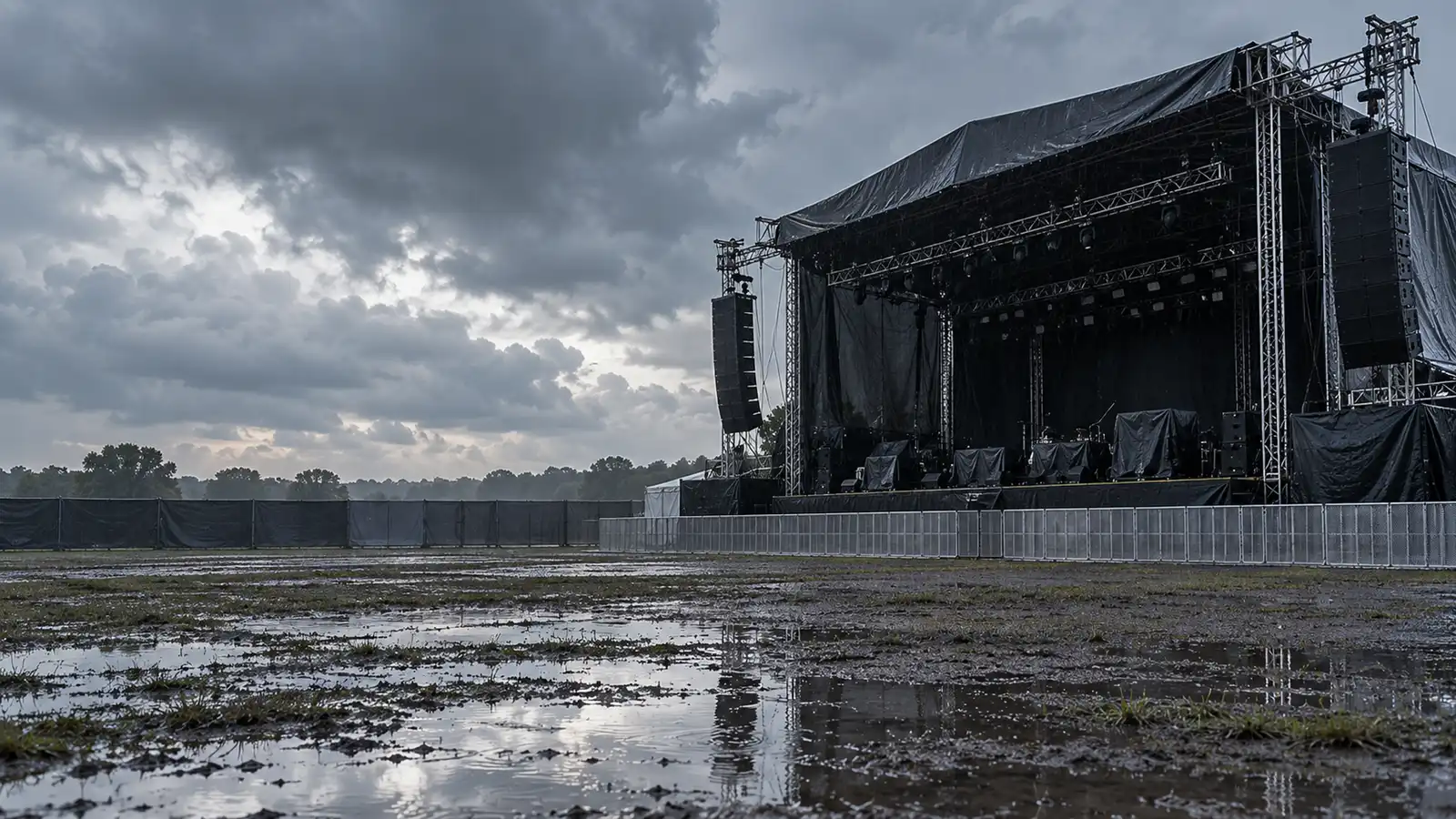
A weather claim. A typical example: severe weather arrives days before an outdoor event, the authorities stop it on safety grounds, and a loss adjuster attends to assess the claim. In our events specialist's experience, weather is the most common cause of event cancellation claims.
Many events that need cancellation cover also need event public liability, which is usually quoted alongside it.
FREQUENTLY ASKED QUESTIONS
QUOTE REQUEST
Tell us the event, the date, the venue, your budget and whether you want to insure costs or gross revenue. We will approach specialist markets that write event cancellation and come back to you with the options available.
Venue deposits, artist fees and production costs are paid long before the gates open. Cancellation cover can protect them if the event cannot go ahead for an insured reason, and it needs to be in place well before the event.
Last updated: 01/10/2026