
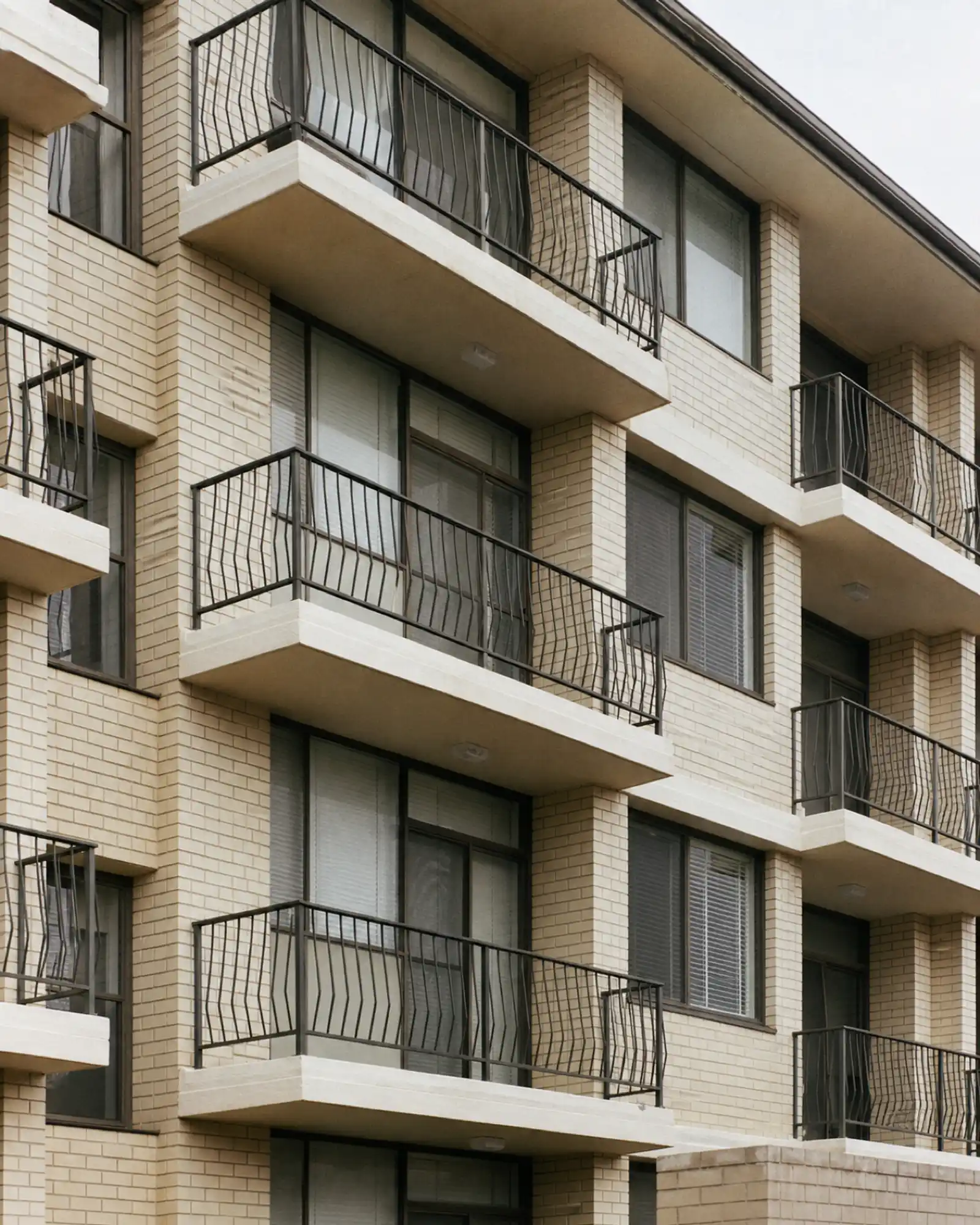
Insurance for Large Blocks of Units and Apartment Buildings
For blocks of 10 or more units, or buildings worth $3 million or more, on one title. Past that size, retail landlord products generally stop fitting, and the cover is usually written by specialist underwriters by referral. That's the market we work in.
10+
Units on one title
$3M+
Building sums insured
$5-26K+
Typical larger-block premiums (approx.)
Recognition

THE SHORT ANSWER
A block of 10 or more units, or a residential building insured for $3 million or more, held on one title is insured as a whole building on a single block of units policy. At that size the risk is generally past the limits of retail landlord products and is usually written by specialist underwriters and commercial insurers by referral. Larger blocks in our portfolio have mostly run from around $5,000 to $26,100 a year, and bigger or more complex buildings can sit above that.
If the building is subdivided under a strata plan with an owners corporation, it needs strata insurance instead. For blocks of two to nine units, start with our block of units insurance guide.
01WHAT CHANGES AT THIS SIZE
Six Things That Change Above 10 Units or $3 Million
The cover is the same idea as for a small block: the building, loss of rent and liability on one policy. What changes is who can write it and what they need to see.
The Unit Count
Retail landlord and home products are built for one dwelling, or a handful on one title. Once a block goes past the product's unit limit, it can't be issued on that product at any premium, so the building has to go to a market that writes whole blocks.
The Building Value
The same applies to the building sum insured. A $5 million or $8 million building can sit above what a standard product writes on its own authority, so an underwriter reviews the risk by referral rather than an online rating engine.
Referral, Not an Online Quote
At this size a person, not a rating engine, decides the terms. The underwriter reads the submission, asks questions and prices the building. A complete submission is what gets terms back quickly and on the right basis. Our large-block quote checklist sets out what they ask for.
Loss of Rent at Scale
A rent roll of several hundred thousand dollars a year, and a loss of rent limit to match, is a large number to protect, and it can be the figure that decides which market can take the risk. The limit and the indemnity period both need setting against a realistic rebuild. See loss of rent for a whole block.
Storeys, Lifts and Basements
Four or more storeys, a lift or a basement car park changes the rebuild cost and the questions an underwriter asks about fire protection, plant and water entry. See multi-storey blocks with lifts and basements.
The Owner
A large block may be held by a company, a family trust or a super fund. The insured name needs to match the title exactly, with the trustee and the trust both named where a trust owns it, and any lender noted. Our trust and SMSF-owned property page covers the naming.
LARGE BLOCK QUOTE
Send the unit count, the building value and the rent roll
Those three numbers tell us which markets fit. Add your current schedule and renewal date, and we'll come back with the terms available.
02WHO WRITES LARGE BLOCKS
A Narrower Market, Placed on the Detail
Large residential blocks on one title are written by a narrower set of markets: specialist underwriting agencies and commercial property insurers. Which one fits depends on the unit count, the building value, the construction, the location and the loss of rent.
Our job is to send each of them a complete submission, chase the underwriter's questions and, where more than one market offers terms, put them side by side so you choose on the cover as well as the price.
We act for you, not the insurer. If a market prices the building on an assumption that's wrong, like a sum insured basis or a construction type, we go back with the evidence.
-
Building
The structure, fixtures, common areas and site improvements, insured for the full cost to rebuild, including demolition, removal of debris and professional fees. On a multi-storey building that figure is rarely the purchase price.
-
Loss of rent
The rent the building stops earning while it's repaired after an insured event, up to a limit and for an indemnity period you set.
-
Public liability
Injury or property damage claims arising from the building and its common areas: stairwells, lifts, driveways, car parks and grounds.
-
Common area contents and plant
Carpets, furnishings and equipment in common areas, and the question of whether lifts, pumps and fire panels need machinery breakdown cover on top.
What it costs: Larger blocks in our portfolio have mostly run from around $5,000 to $26,100 a year, and bigger or more complex buildings can sit above that. Your building will be rated on its own details. The block of units cost guide covers smaller blocks.
CLIENT SUCCESS
Large Blocks: How These Buildings Were Placed
Recent Tank placements, anonymised. Premiums are approximate gross figures and reflect each risk at the time. They're not a guide to future pricing or turnaround, and insurer appetite changes.
Premiums and outcomes described are specific to each client and indicative only. Your own terms will depend on your circumstances and the insurer.
LARGE BLOCK FAQS
Common Questions About Insuring a Large Block of Units
LARGE BLOCK GUIDES
More on Insuring a Large Block
Renewal close, or a building past the online limits? Call 02 9000 1155 and we'll tell you which markets fit.
Talk to Our Team →
Get a Quote for a Large Block of Units
Send the address, the unit count, the building sum insured and the rent roll. We'll send a complete submission to the markets that write whole blocks and, where more than one offers terms, put them side by side.