
Contents
How long does business insurance take to arrange in Australia? We got tired of guessing, so we timed it. We measured the calendar days from the moment an enquiry landed to the day cover was actually bound, across around a thousand policies we placed between 2023 and 2026.
The answer wasn’t what we expected. The product barely mattered.
The short answer
Across around a thousand bound policies in our own records, the median time from first enquiry to cover being bound was roughly a fortnight. Roughly one in fourteen were bound inside 24 hours, about a third inside a week, more than half inside two weeks, and four in five inside a month. Where the information is ready and the risk is straightforward, same-day cover is realistic.
How we measured it. These are policies we actually bound, not enquiries that didn’t end up binding. We also set aside about three in ten of them, where more than 90 days passed between the enquiry and cover being bound. Those are files that paused and were picked up again at a later renewal, so they measure the gap between two conversations rather than the work itself. What’s left is the working clock: enquiry in, cover on.
How long does each type of business insurance take?
Between roughly 11 and 14 days at the median, whichever product you look at. That was the surprise. The gap between the fastest product and the slowest is a couple of days. The gap between the fastest and slowest placement within a single product is weeks.
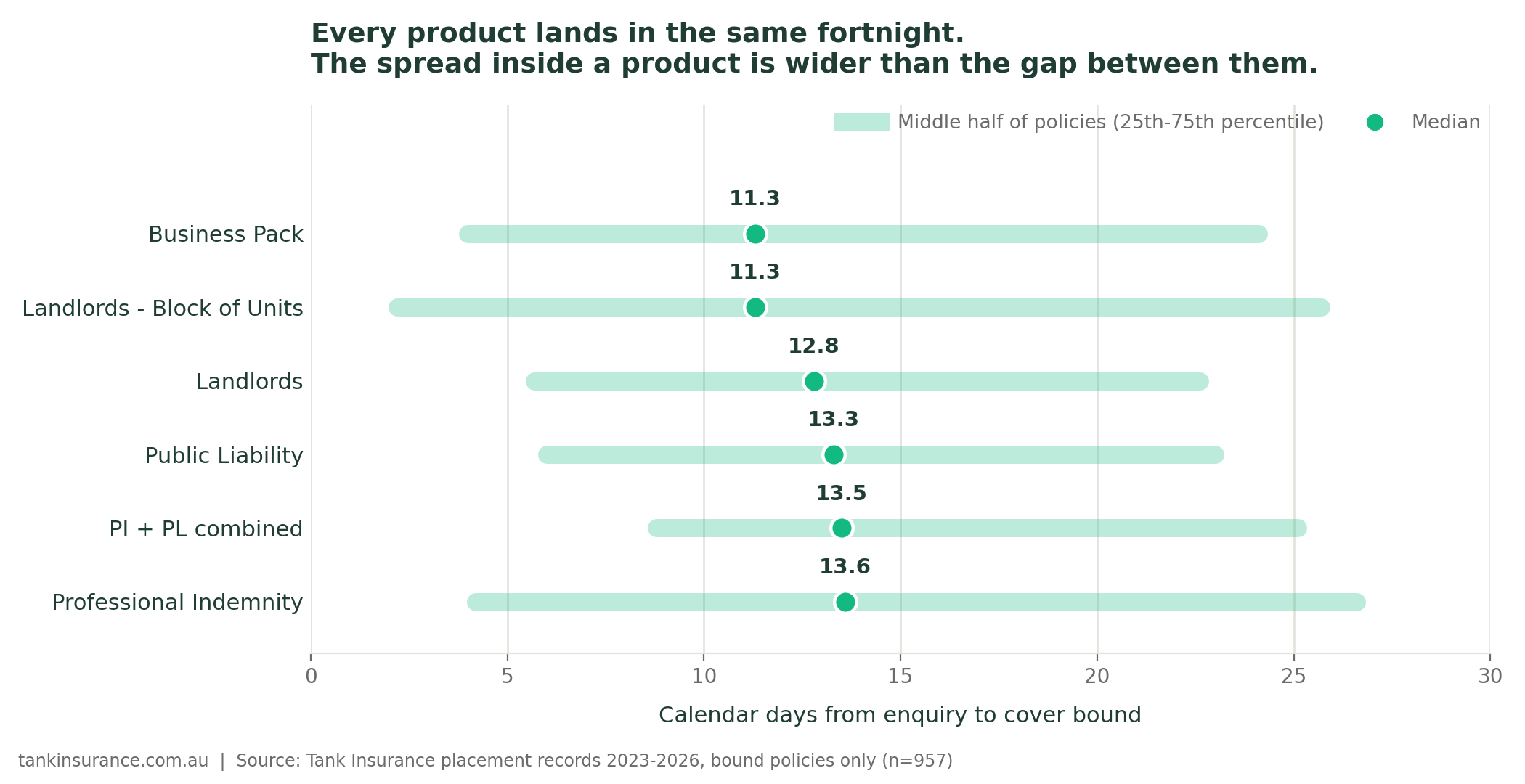
Source: Tank Insurance placement records 2023 to 2026, bound policies only, excluding files where more than 90 days elapsed (n=957). Observed values from our own book, not market-wide rates. Past timings are not a guarantee of how long any particular placement will take.
| Product | Policies measured | Median days | Middle half of policies |
|---|---|---|---|
| Business Pack | 127 | 11.3 | 4 to 24 days |
| Landlords - Block of Units | 77 | 11.3 | 2 to 26 days |
| Landlords | 174 | 12.8 | 6 to 23 days |
| Public Liability | 100 | 13.3 | 6 to 23 days |
| PI and PL combined | 68 | 13.5 | 9 to 25 days |
| Professional Indemnity | 74 | 13.6 | 4 to 27 days |
Read the medians and they sit close together. Read the right-hand column and you can see where the variation actually lives: inside each product, not between them.
Block of units insurance is the clearest example. Half of those policies were bound within about 11 days, and a quarter within about two days, but the slower quarter stretched past three and a half weeks. Same product, very different timelines.
Why does the same cover bind in two days on one file and four weeks on another?
Because the elapsed time includes everything, not just the underwriting. Our data measures one interval, enquiry to bind, and it doesn’t split that interval into who was waiting on whom. So treat what follows as our read of the files behind the numbers rather than something the numbers themselves prove.
What we see is that the long ones are usually waiting on information, not on a decision from an insurer. The General Insurance Code of Practice sets timeframes for insurers responding to requests for information, and on a standard risk that part tends not to be where the weeks go.
That reframes the original assumption. We expected questionnaire-heavy covers like professional indemnity to run long, because the proposal form asks for an activities breakdown, contract profile and five years of claims history. It does ask for all of that, and it still came in at a median of 13.6 days.
Size doesn’t decide it either. A large property placement can bind faster than a small liability policy when the information is cleaner.
What actually compresses the timeline?
Having your information ready before you ask for a quote. The fastest placements are the ones where the picture is complete from the outset. Every question an insurer raises that can’t be answered straight away is another round trip, and round trips are where the days go.
Concretely, that means having ready:
- Financials. Revenue for the last financial year and an estimate for the next. Splits by activity if you do more than one thing.
- Claims history. Five years, including incidents that didn’t become claims. “None” is a complete answer, and worth confirming before you start.
- Sums insured. Building, contents, stock, machinery. If you’re insuring property, know the rebuild value, not the market value.
- Completed questionnaires. For PI and cyber, the proposal form is the underwriting. Block out an hour and do it in one sitting.
- Subjectivities turned around quickly. When an insurer offers terms subject to conditions (eg a survey, an alarm upgrade confirmation, a signed declaration), the clock runs until those are met. Knowing they’re coming, and who needs to action them, is usually what separates the fast quarter from the slow one.
If you’re starting a project rather than a business, the same logic applies but the clock matters more. Contract works insurance is best arranged before works start, because cover for a project that’s already underway is a harder conversation.
The other compression lever is process. We’ve built our process around getting the full picture in the first conversation, precisely so the insurer’s questions get answered in as few round trips as possible.
When do I actually have cover?
Cover starts when the policy is bound or the insurer agrees to hold you covered, not when you receive a quote. A quote is an offer with an expiry date. Until you accept it and the insurer confirms cover, you’re not protected.
The sequence usually runs: quote, your acceptance, binding confirmation from the insurer, then policy documents. If a landlord, principal or client needs proof, that’s a certificate of currency, which can typically be issued as soon as cover is bound. You don’t need to wait for the full policy wording to land.
Worth checking with your broker exactly which of these stages you’re at. “We’ve got a quote” and “we’re covered” are different sentences.
Frequently asked questions
Can I get business insurance the same day?
Often, yes. Roughly one in fourteen of the policies we measured were bound inside 24 hours. If the risk fits standard underwriting appetite and your details are ready, straightforward covers like public liability can be quoted and bound the same day. The medians in our data are longer because the clock includes time spent gathering information, comparing quotes and deciding, not just the insurer’s turnaround.
What holds a quote up?
Quotes generally stall on missing information: unanswered questionnaire sections, unknown sums insured, unconfirmed claims history, or slow responses to insurer subjectivities. Complex or unusual risks that need referral to an underwriter also add days at each round trip.
When do I actually have cover: quote, binder or policy?
A quote is only an offer, and it doesn’t protect you. Cover starts when the insurer agrees to hold you covered or the policy is bound, which your broker confirms in writing. Policy documents and a certificate of currency typically follow after binding.
What should I have ready before asking for a quote?
Your ABN and business activity description, revenue figures, staff numbers, claims history for the past five years, sums insured for property and contents, and any contracts that specify required limits. For professional indemnity and cyber, expect a questionnaire, so set aside time to complete it in one sitting.
Ready to start the clock?
The pattern is consistent: the less back-and-forth, the sooner cover is in place. If you want it arranged with a clear picture of your business given up front, get insured online or contact us directly.
Call us on 02 9000 1155 or email [email protected].