
Contents
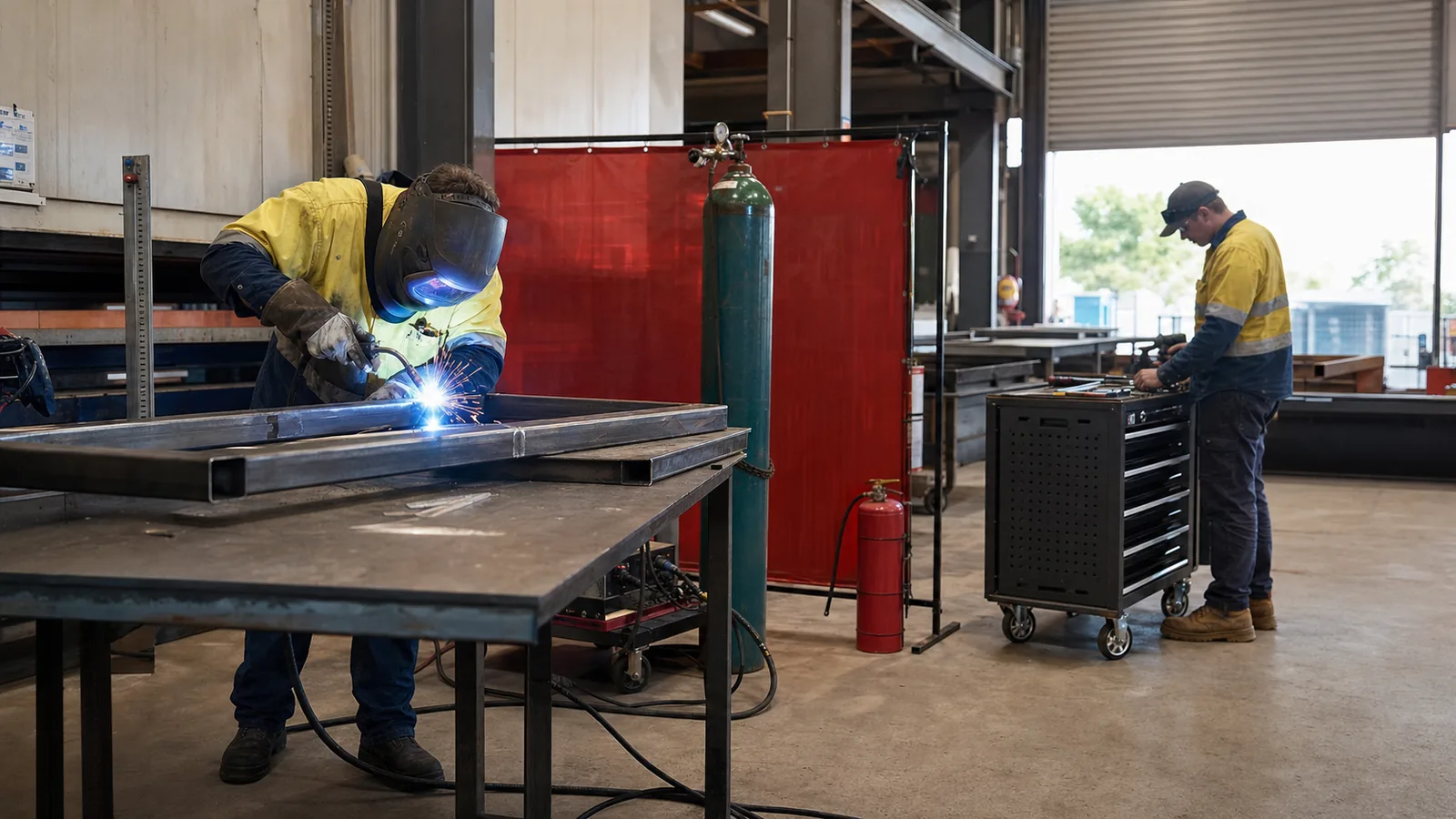
Boilermaker and welder insurance needs to follow the work. Steel may begin in a workshop, travel on a truck and finish as installed work at someone else’s site. Tools, fabricated components, vehicles and liability don’t all sit under the same policy section.
The useful question for 2026 isn’t simply “am I insured?” It is: what happens at each stage, who owns the property, and which policy is intended to respond?
What insurance can a boilermaker or welder consider?
A boilermaker or welder can consider public liability, business property, tools, commercial motor and transit cover. Contractual requirements, work at height, hot work, installation and the type of fabricated product can also affect the submission.
The boilermaker and welder insurance page gives the industry overview. This table turns it into a job-flow map.
| Stage | Exposure to describe | Cover to discuss |
|---|---|---|
| Workshop | Building, stock, machinery, fire and interruption | Business property and interruption |
| Loading | Component damage and lifting responsibility | Property, transit and liability |
| Road | Vehicle damage and carried goods | Commercial motor and transit |
| Job site | Third-party injury or property damage allegations | Public liability |
| After installation | Completed work or product allegation | Public or products liability, subject to wording |
This doesn’t mean every business requires every section. It gives the broker and underwriter a structured way to test the proposed programme.
How do tools, workshop and transit cover connect?
They connect through ownership, location and handover. Tools insurance is property cover for specified or defined equipment, while transit insurance addresses covered loss or damage while goods are moving under the insured’s responsibility.
A workshop policy may not automatically follow a welding unit to a remote site. Likewise, a transit section may not insure the vehicle carrying the goods. The vehicle can be discussed under commercial motor insurance, while the components need separate analysis through transit insurance.
Prepare a list that separates fixed machinery, portable tools, hired equipment, customer property and completed fabrications. Add where each item is stored overnight and how it is secured.
Why do workshop and site activities need separate detail?
Workshop and site work present different underwriting facts. The workshop has a fixed address, construction, fire controls, extraction, stock and machinery. Site work adds changing locations, principal-contractor rules, other trades and access conditions.
Safe Work Australia has reduced the workplace exposure standard for total welding fumes to 1 mg/m3 over an eight-hour working day, based on a five-day working week. The reduced standard takes effect when it is implemented in a jurisdiction, so confirm the position with your state or territory WHS regulator. Its welding fumes guidance also directs businesses to assess the process and work environment and review controls.
That is a WHS requirement, not an insurance benefit. Risk controls can still be relevant underwriting information, so document extraction, hot-work procedures, training and site permits accurately.
What should a welder give a broker?
A strong submission explains the work without expecting the underwriter to decode a trade name. Consider including:
- The percentage split between workshop fabrication and site work.
- Metals, processes and finished products handled.
- Maximum working height and lifting methods.
- Fixed machinery, portable tools and stock values.
- Vehicle, trailer and goods-in-transit details.
- Hot-work, fume-control and fire-protection procedures.
- Subcontractor use and insurance checks.
- Contracts, claims history and any required limits.
For broader packaging, compare business insurance with a dedicated public liability discussion. The aim is a programme that follows the real workflow, not a pile of overlapping labels.
Frequently asked questions
Does public liability cover a welder’s tools?
Generally no. Tools and equipment normally require a separate property or portable equipment section.
Can one policy cover workshop and site welding?
A package may address both, but the activities and locations must be disclosed and each policy section has its own terms, limits and exclusions.
Is transit cover needed for fabricated components?
It may be relevant where the business retains responsibility for components while they are being carried, loaded or unloaded. Contracts and delivery terms help establish the handover point.
To discuss a submission, call Tank Insurance on 02 9000 1155 or email [email protected].