
Contents
Which Australian state has the most expensive property insurance? We stopped guessing and pulled the answer from our own records. Across 245 property placements with a recorded location in our book (2023-2026), the property insurance cost by state ranged from a median of approximately $1,900 in Victoria to approximately $3,200 in North Queensland.
That’s the headline. The more interesting story is the spread inside each state, and why insurers price a Cairns warehouse so differently to a Melbourne shopfront.
The short answer
Measured across 245 property placements in Tank Insurance’s records from 2023 to 2026, the median observed premium was lowest in VIC at approximately $1,900 and highest in North QLD at approximately $3,200. NSW showed the widest spread: a median of approximately $2,700, but a 75th percentile of approximately $5,500. These are observed figures from our own book, not market-wide statistics, and only a minority of our deals had a property location recorded.
What did we actually measure?
We took every deal in our records from 2023 to 2026 with both a recorded property location and a premium, 245 in total, and calculated the median and 75th percentile premium per state, rounded up to the nearest $100.
Three caveats before you read anything into the numbers.
First, only a minority of our deals had the property location recorded, so this is a sample of our book, not the whole of it. Second, the product mix isn’t controlled: the dataset blends landlord policies, blocks of units, and commercial property, and the mix differs by state. Third, the NSW (n=16) and North QLD (n=10) cells are small, so treat those figures as directional.
| State | Deals (n) | Median premium (approx.) | 75th percentile (approx.) |
|---|---|---|---|
| VIC | 110 | $1,900 | $2,300 |
| TAS | 17 | $2,300 | $2,300 |
| WA | 92 | $2,300 | $2,600 |
| NSW | 16 | $2,700 | $5,500 |
| North QLD | 10 | $3,200 | $3,500 |
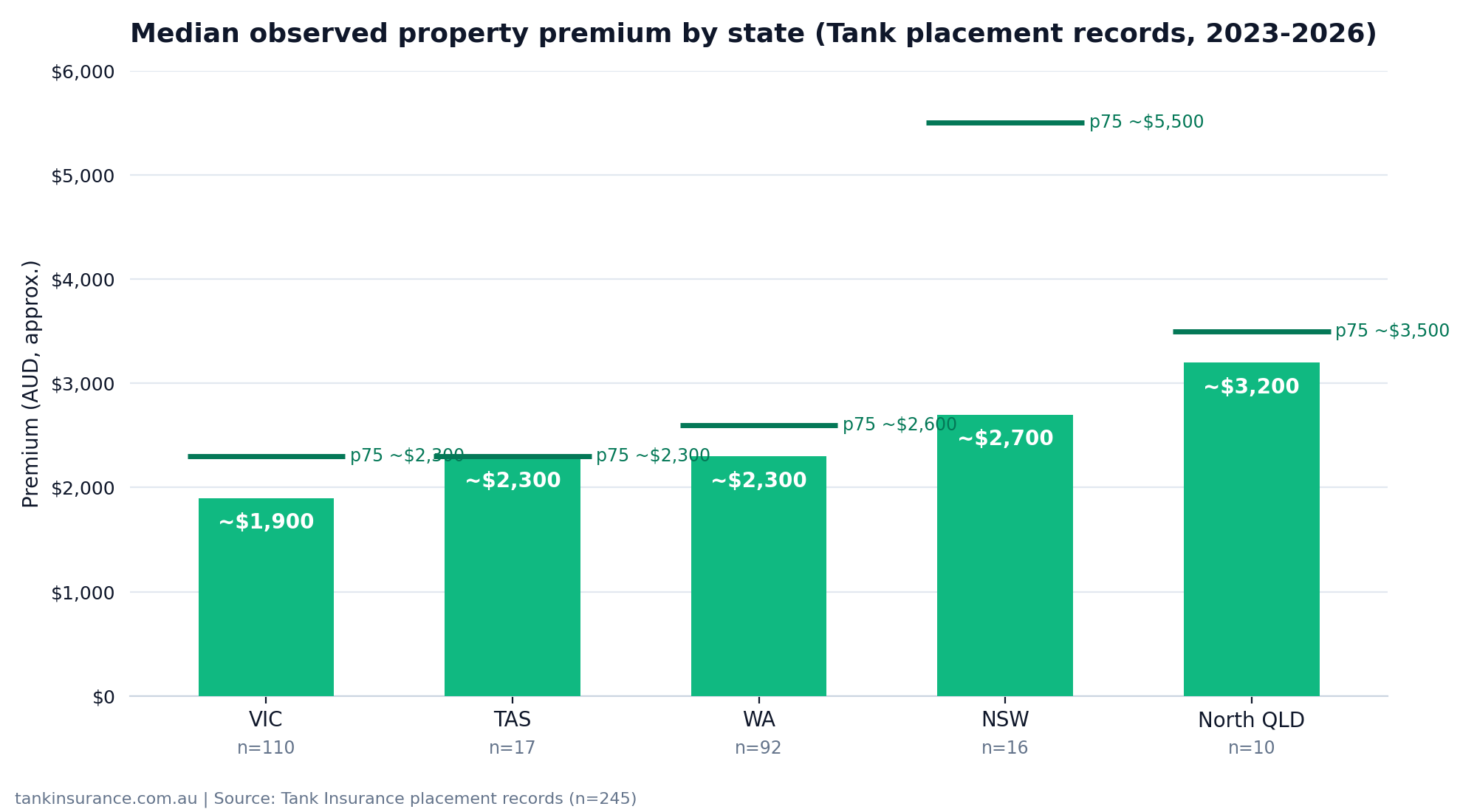
Source: Tank Insurance placement records, 2023-2026 (n=245). Figures are observed values from our book, not market-wide rates.
Why is North Queensland the most expensive?
In our observed data, North QLD carried the highest median at approximately $3,200, and the mechanism is mostly reinsurance and appetite, not individual buildings being worse.
Insurers buy reinsurance to protect themselves against large accumulation events, and reinsurers charge more for portfolios concentrated in cyclone-exposed regions. That cost gets loaded into every premium in the region, regardless of how well an individual building is maintained.
The second mechanism is competition. Fewer insurers hold appetite for cyclone-exposed property, and when fewer markets are quoting the same risk, there’s less price tension pushing premiums down. The federal government established the Australian Reinsurance Pool Corporation cyclone pool in 2022 partly to address this dynamic, backing insurers that write cyclone-exposed risk.
Neither mechanism says anything about how likely your specific building is to claim. It’s how the market prices the region, and it’s why presenting a North QLD risk well matters so much.
Why is the NSW spread so wide?
NSW showed the biggest gap between typical and expensive in our data: a median of approximately $2,700 but a 75th percentile of approximately $5,500, against a VIC 75th percentile of approximately $2,300.
In other words, the dearer quarter of our NSW placements cost more than double the dearer quarter of our VIC placements. A few things stack up in NSW.
NSW still funds emergency services partly through a levy on insurance premiums, while several other states have shifted to property-based funding. The levy sits on the invoice on top of base premium, GST, and stamp duty, so the same base rate produces a bigger final number in NSW.
Rebuild costs in parts of Sydney can also push sums insured up, and premium scales with sum insured. And our NSW sample is small (n=16) with an uncontrolled mix of property types, so treat that p75 as a signal rather than a rate. If your NSW property has a complication on top, say it sits in a mapped flood zone, the spread widens further.
What can owners in higher-cost states do about it?
You can’t move your building, but you can change how the market sees it and how the policy is structured.
- Present the risk properly. Roof age, recent maintenance, updated wiring or plumbing, and a clean claims history all belong in the submission. Underwriters price what’s in front of them, and a thin submission gets a cautious price.
- Consider your excess options. A higher excess shifts small claims back to you in exchange for a lower premium. Worth modelling if you’d never claim under a few thousand dollars anyway.
- Use a broker with underwriting agency access. When mainstream appetite thins, underwriting agencies and specialist markets often still quote. That access is the difference between one reluctant quote and a genuine comparison.
- Review your sum insured annually. Rebuild costs have moved sharply in recent years. Under-insure and you risk co-insurance penalties at claim time; over-insure and you’re paying premium for cover you can’t use.
For the national picture on what drives these premiums up and down, our landlord insurance cost guide for 2026 is the companion read on cost drivers.
Frequently asked questions
Is North Queensland property uninsurable?
No. Fewer insurers offer terms in cyclone-exposed regions, so options are narrower and pricing tends to sit higher, but cover is available. Specialist markets and underwriting agencies write North QLD property, and the ARPC cyclone pool supports insurers operating there. If you’ve struggled to get terms, the question worth asking is whether the right markets were approached.
Does a flood zone always mean a higher premium?
Not automatically. Pricing depends on the specific flood mapping for your address, the building’s elevation, and whether flood cover is included or excluded on the policy. Some markets assess the individual address rather than pricing off a postcode, which can produce a very different outcome for the same property.
Do government levies differ by state?
Yes. NSW applies an Emergency Services Levy to insurance premiums, while several other states have shifted to property-based funding for emergency services. Stamp duty on insurance also varies between states. Two identical base premiums can land as noticeably different invoices depending on which state the property sits in.
Why is my premium higher than my interstate friend’s?
State effects are real, but individual factors usually move the price more. Construction type, building age, sum insured, occupancy, claims history, and excess all feed the rate. Two similar buildings in different states can price differently, and so can two buildings on the same street. Compare like with like before assuming you’re being overcharged.
How reliable is this data?
It’s observed data from 245 placements in our own records, 2023-2026. Only a minority of deals had a location recorded, the product mix isn’t controlled, and the NSW and North QLD samples are small. Use it to understand the mechanisms, not as a quote for your building.
Want a proper read on your property’s premium?
If your renewal has jumped or your state seems to be working against you, we’ll tell you whether it’s the market or the way the risk is being presented. Call us on 02 9000 1155, email [email protected], or get in touch online and we’ll take a look.