
Contents
Your renewal notice lands, the premium is up, and the obvious question follows: is a business insurance renewal increase just what happens every year, or is your policy the exception?
We wanted a real answer, so we measured it. We took 44 back-to-back renewals from Tank Insurance’s own placement records, consecutive placements for the same client and the same product, 180 to 550 days apart, between 2023 and 2026, and tracked how the premium moved from one year to the next.
The short version: no, premiums don’t automatically go up every year. But the pattern behind that answer is more interesting, and more useful, than the average suggests.
The direct answer
Across 44 back-to-back renewals in Tank Insurance’s records (same client, same product, 2023-2026), the median premium movement was 0.0%. The middle 50% of renewals moved between -3.0% and +9.6%, and at least a quarter renewed at a lower premium. But 18% of renewals rose by more than 20%. Most renewals drift; a minority jump hard.
What did the 44 renewals actually show?
The median movement was flat, and the typical renewal moved between -3.0% and +9.6%. That’s the middle of our book, measured, not estimated.
Here’s the full picture:
| Measure | Movement |
|---|---|
| 25th percentile | -3.0% |
| Median | 0.0% |
| 75th percentile | +9.6% |
| Share that rose more than 20% | 18% |
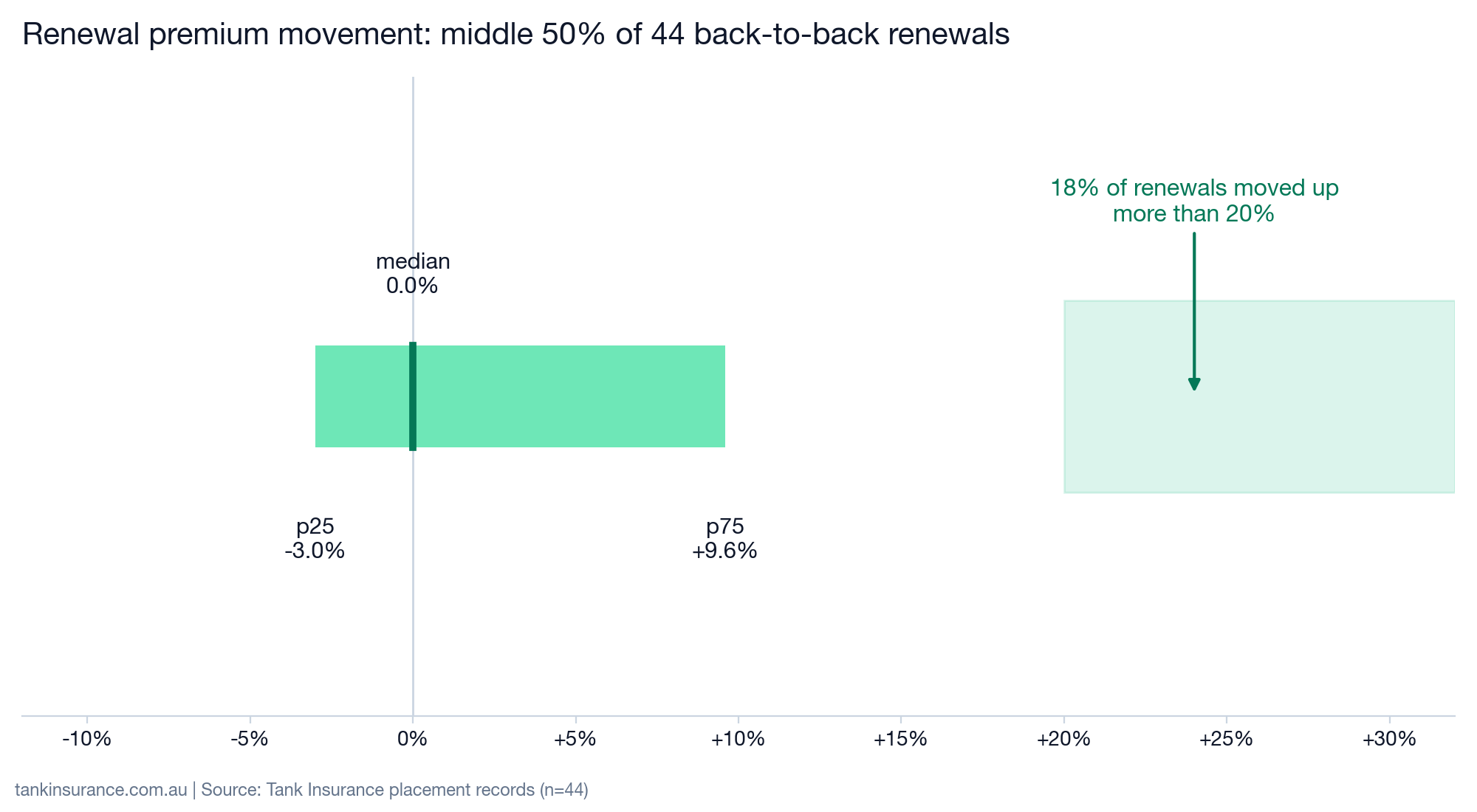
Source: Tank Insurance placement records, 2023-2026 (n=44). Figures are observed values from our book, not market-wide rates.
One caveat worth stating plainly: these are premium-to-premium comparisons from our records, so fees and changed sums insured can be embedded in the movements. A renewal that “rose 12%” might include a higher sum insured after a revaluation, not just a rate increase.
And this is Tank’s book, not the Australian market. We’re not claiming market-wide trends here, just showing you what 44 real renewals did.
So do premiums go up every year or not?
For most policies in our sample, no. Half moved 0% or less. The average renewal experience in our data was drift, a few percent either way, not a steady annual climb.
That surprised us less than the shape of the distribution did. Renewals in our sample were asymmetric.
The middle of the downside was shallow: the 25th percentile sat at -3.0%, so the typical reduction was modest. The upside had a fat tail: 18% of renewals jumped more than 20%.
In other words, “what happens at renewal” isn’t one question. It’s two:
- Most of the time: small movement, sometimes down. Not worth panic.
- Roughly one in five times (in our sample): a jump of 20%+ that deserves a hard look.
If you only remember one thing from this post, make it that split. An “average increase” figure hides the tail, and the tail is where the money is.
What makes a premium jump 20% or more?
Big jumps have identifiable mechanisms. When a renewal moves hard, there’s a short list of mechanisms that can drive it:
- A claim in the period. A paid or open claim changes how the insurer rates the risk, and the renewal price reflects it.
- Insurer appetite shifting away from the risk class. If an insurer decides it wants less exposure to your occupation, construction type, or region, it can price accordingly rather than decline outright. The premium does the talking.
- A property revaluation lifting the sum insured. Rebuild costs get reassessed, the sum insured rises, and the premium rises with it, even at the same rate.
- An insurer exiting, and the replacement pricing fresh. When your holding insurer leaves a segment, the incoming insurer prices your risk from scratch with no incumbency discount and no history with you.
None of these require you to have done anything wrong. Which is exactly why a big jump warrants a market test rather than a shrug: the mechanism behind it might be specific to your insurer, not your risk.
We’ve written before about why the renewal offer isn’t the market price. This post is the data companion to that argument: the numbers above are what those renewal offers actually did across our book.
What should you do with this at your next renewal?
Match your effort to the movement. The data points to a simple triage:
| Your renewal movement | What it suggests |
|---|---|
| Down, or up less than ~10% | Inside the typical band in our sample. Review cover and sums insured, but the price alone isn’t alarming. |
| Up 10-20% | Outside the middle 50% of our sample. Worth asking your broker why, and what else the market offers. |
| Up more than 20% | The fat tail. Re-shop it properly, and ask which mechanism above is driving it. |
Moneysmart’s insurance guides cover the basics of reviewing cover from the consumer side; the data above is the business-renewal picture from inside a broker’s book.
The mistake at both ends is treating every renewal the same. Panicking over a 4% rise wastes energy. Waving through a 30% rise because “insurance always goes up” costs real money, because in our sample it demonstrably doesn’t always go up.
A business insurance broker earns their keep at the tail. When a renewal jumps hard, the questions that matter are which insurers still want the risk, whether the sum insured actually needs to move, and whether the incumbent’s price reflects the market or just their appetite. That’s the work described in our process, and our insurance renewal guide walks through the timeline for getting ahead of it.
Frequently asked questions
Is a small increase at renewal normal?
In our sample of 44 back-to-back renewals, the middle 50% of movements ran from -3.0% to +9.6%, so single-digit drift in either direction sat comfortably inside the typical band. A small increase on its own isn’t a red flag. It’s still worth a quick sense-check that your sums insured and cover match the business you’re running now.
Should I get comparison quotes every year?
It depends on the movement. If your renewal lands within a few percent of last year, a light-touch review of cover and sums insured may be enough. If it jumps 20% or more, that’s the signal to test the market properly, because that’s where the biggest movements in our sample sat.
Why did my premium jump when I had no claims?
A big jump can happen without a claim. Mechanisms include an insurer shifting appetite away from your risk class, a property revaluation lifting the sum insured, or your insurer exiting the segment so a replacement insurer prices the risk fresh. Fees and changed sums insured can also sit inside the headline movement, so the “rate” may have moved less than the invoice suggests.
Can business insurance premiums go down at renewal?
Yes. In our sample, at least a quarter of renewals came in at a lower premium than the year before, and the 25th percentile of movements was -3.0%. Premiums aren’t a one-way street, which is exactly why accepting the renewal offer without looking isn’t a strategy.
Talk to us before your next renewal
If your renewal has landed with a jump you can’t explain, send it over. We’ll tell you whether it’s drift or a genuine outlier, and what the rest of the market thinks of your risk.
Call us on 02 9000 1155, email [email protected], or contact our team.