
Contents
Back in January I said this would be the first of many notes. Then I wrote nothing for six months. So much for building in public (lol).
To be very honest, it’s got busy and my main focus with the team has been to serve all of our customers and partners. And I didn’t have anything significant to share. This morning though, I had some thoughts and wanted to get pen to paper, so here it is!
Key Takeaways:
- We had a hunch that more clients were asking us to get the US included on their liability cover, so we checked our own file notes to confirm
- The hunch held up, but the shape of it was different to what I assumed
- Clients are increasingly arriving having already read our case studies, so we’ve been adding a lot more of them
- Stamp duty exemption declarations, letters of appointment and authorities to quote are now digital, prefilled and e-signed rather than printed and scanned
- Sustained engineer enquiry volume pushed us to put our proposal form online, and clients have taken to it faster than we expected
- We’ve been putting real time into training the team now, to prepare for what’s ahead
Testing a Hunch Instead of Repeating It
For a while now I’ve had a feeling that more of our clients are asking about the United States.
And this is just from hearing the team speak to our customers about this and also being on calls myself with customers. There definitely was a feeling that it was being requested more. Most liability (PL & PI) policies in the Australian market are written as worldwide excluding USA and Canada. That exclusion is the default.
What I felt like I was seeing was more clients coming to us and needing that exclusion pulled back. Businesses selling into the US, or advising a client who’s entering the US market, or sitting under a US parent company. And needing the cover to follow them there.
So I wanted to see what our data said…
We went back through our own file notes across the last couple of years and counted.
What the numbers said
The honest answer is ..
Yes, but not in the way I thought.
Compared with our 2025 baseline, requests where a client actually needed US exposure covered are running at roughly five times the rate they were.
But here’s the bit I had wrong. I assumed this was a recent thing, something that had built up over July. It wasn’t. The step up happened back around March, and it has held at that higher level ever since. June was quiet. July was our biggest month for it on record, but the shift itself is months old and I’d simply been noticing / actually realising it late.
Here’s what that looks like. Each bar is how often US cover came up as a share of our enquiries that month, measured against our 2025 average.
You can see the problem with trusting a gut feel. Look at March through May and you’d say this has been running hot all year. Look at June on its own and you’d say nothing’s happening. Neither month is the truth by itself.
June is worth explaining, because it isn’t really a slowdown. End of financial year is the heaviest stretch of our calendar, and the 30 June renewal cycle straddles June and July. Our renewal load in July was the biggest it’s been since January. So June was spent heads-down on work that had to happen on a deadline, and the newer, more exploratory conversations simply got fewer.
Which is why July reads as a good month to me. Coming out of an EOFY period that busy and landing back at the top of the range, while also getting the other things below done, is more pleasing than the bar on its own suggests.
Why the exclusion matters more than it sounds
This is one of those clauses that reads like paperwork until the day it doesn’t.
US and Canadian jurisdiction gets excluded as standard because the litigation environment there carries a different cost profile to Australia’s. Insurers price for what they can predict, and a US claim is a different beast altogether.
So if your business has drifted into US work, and nobody has revisited the territory and jurisdiction clauses on your professional indemnity and public liability policies, there’s a real chance the exposure you actually carry and the cover you actually hold have quietly stopped matching.
The good news is that it’s often solvable. Depending on the insurer and the risk, US jurisdiction can sometimes be added back, frequently with its own sublimit rather than the full policy limit.
A lot of this is showing up in our life sciences work, where product liability, product recall and professional indemnity tend to travel together and where selling into the US is often the whole point of the business. Another is management consulting with international reach, including the US.
Clients Are Turning Up Already Knowing
The other thing that stood out this month had nothing to do with data.
We’ve had a few clients reach out because they’d read a case study on our site and recognised themselves in it. They’d come to us saying, essentially, my situation looks a lot like that one, can you help.
I didn’t expect how much that would change the first call.
Normally a first conversation involves a fair bit of groundwork. What the cover does, why a risk gets priced the way it does, why one insurer says no and another says yes. That’s necessary, but it takes time and it can feel like a lecture when someone just wants an answer.
When someone has already read a similar case, they arrive with context. We’re comparing their situation to one they’ve already understood, and we’re talking about options in the first instance a lot quicker.
That’s genuinely made me rethink what our case studies are for. I used to think of them as marketing. They’re not. They’re a way of showing people, honestly and anonymously, what a risk like theirs actually looked like. What the concern was. How many markets we approached. Where the pricing landed.
We never name clients and we never will. But the shape of a policy, the outcome, the range things fell into, all of that is useful to somebody in the same boat trying to work out whether their quote is reasonable. Insurance pricing feels like a black box from the outside. Anything that makes it less of one is worth doing.
So we’ve leaned into it. July was one of our heavier months for publishing new ones, and we’ve deliberately widened the spread rather than just adding more of the same. More professional indemnity scenarios, more property, more life sciences, more of the awkward ones where a risk got knocked back a few times before it found a home.
That last category is the one people seem to find most useful. A clean risk placed easily doesn’t tell you much. A difficult one, where it took several markets and a proper explanation of the work to get a sensible outcome, tells you a lot more about what to expect.
If you want to see what I mean, the case studies are all there.
Getting Out of the Client’s Way
The other big push this month was on the boring stuff. The admin that sits between someone deciding they want cover and actually having it.
Paperwork that doesn’t need a printer
Insurance runs on forms. Some of them are genuinely necessary and some of them are just process, but either way they’ve traditionally meant the same thing for a client: print it, sign it, scan it, send it back. And then wait, because nothing moves until that comes in.
We’ve moved that lot across to digital. Stamp duty exemption declarations, letters of appointment, authorities to quote. Same documents, same legal weight, completely different experience.
What actually happens now is that we prefill it with everything we already know about you, send it straight through, and you review it rather than write it. If something’s wrong, you amend it. If it’s right, you sign it digitally and it’s done. No printer, no scanner, no photographing a form on your kitchen bench at 9pm.
It sounds small. It isn’t. The gap between “we need a signed authority to approach the market” and actually holding one has historically been where days quietly go by on a placement. Closing that gap means we get to market sooner, and getting to market sooner genuinely matters when you’re up against a renewal date, or cover that you need bound as soon as possible.
Putting the proposal form online
The other change came out of volume.
Engineering work has been a real growth area for us. Enquiries stepped up sharply in the first part of this year and have stayed well clear of where they sat through 2025, and while it isn’t the busiest it’s been, it’s held at a level that made the old process one we wanted to look at (and improve).
Engineering proposal forms are detailed, and they should be. Scope of work, revenue split, subcontractor arrangements, contract terms, claims history. Getting that right is what separates a quote that holds up from one that falls over at underwriting. But historically it meant emailing a document and hoping it came back complete, then calling to discuss what was declared before preparing our submission.
So we put our engineers proposal form online, and the response has been better than I expected.
What clients seem to like most is doing it in their own time. They can start it when they enquire, pull their contracts and financials together over a couple of sittings, and upload everything at the point they’re actually looking at it, rather than trying to reconstruct it all on a phone call.
The flow is simple enough:
- Leave an enquiry and we’ll take basic details and organise a call
- Or, if you’d rather get moving, go straight into the proposal form in the first instance and complete it at your own pace
- Either way we then get in touch to confirm the details and make sure everything’s properly signed
- We talk through strategy, which markets we’re approaching and why, and only then do we go to market
That last point is the one I’d underline. The form is not there so we can skip the conversation. It’s there so the conversation is a better one. When we get on the phone and I’ve already got your scope of work and your revenue in front of me, we’re talking about which insurers will actually understand your risk. The idea is to make it easier and provide another option.
If you’re an engineer looking at your renewal, that form is live and you’re welcome to use it.
Training For What’s Ahead
The biggest use of our time in July was something clients won’t see directly …
A serious amount of upskilling across the team.
We’re not training because something broke. We’re training because we’d rather build capability now because I have a vision of building a team of generalist-specialists (which I first discussed in my January 2026 note). I want people who can actually help when they pick up the phone, not people who know one product and pass you along. That doesn’t happen by accident and it doesn’t happen quickly. It happens because you invest in it before you need it.
We’re not a big end of town brokerage and we’re not pretending to be. We’re the broker for SMEs who want someone who’ll actually pick up. Being honest about how we get better at that seems more useful than pretending we arrived fully formed.
Not everything worth mentioning is about training. One of the underwriters we work with sent the whole team a box of Grumpy Donuts this month, purely as a thank you. Small gesture, but the team absolutely loved it.
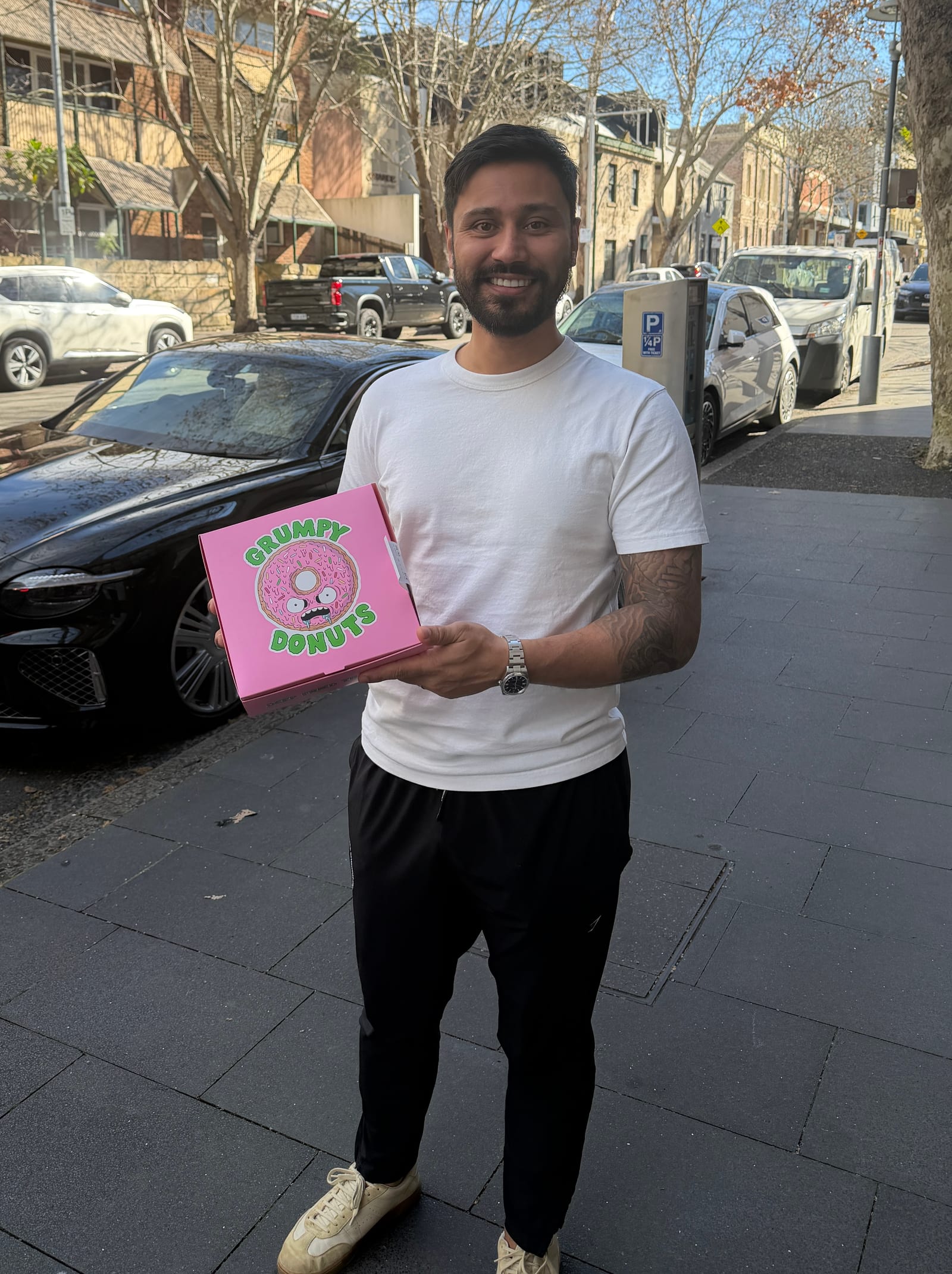
The delivery made it back to the office in one piece. Barely.
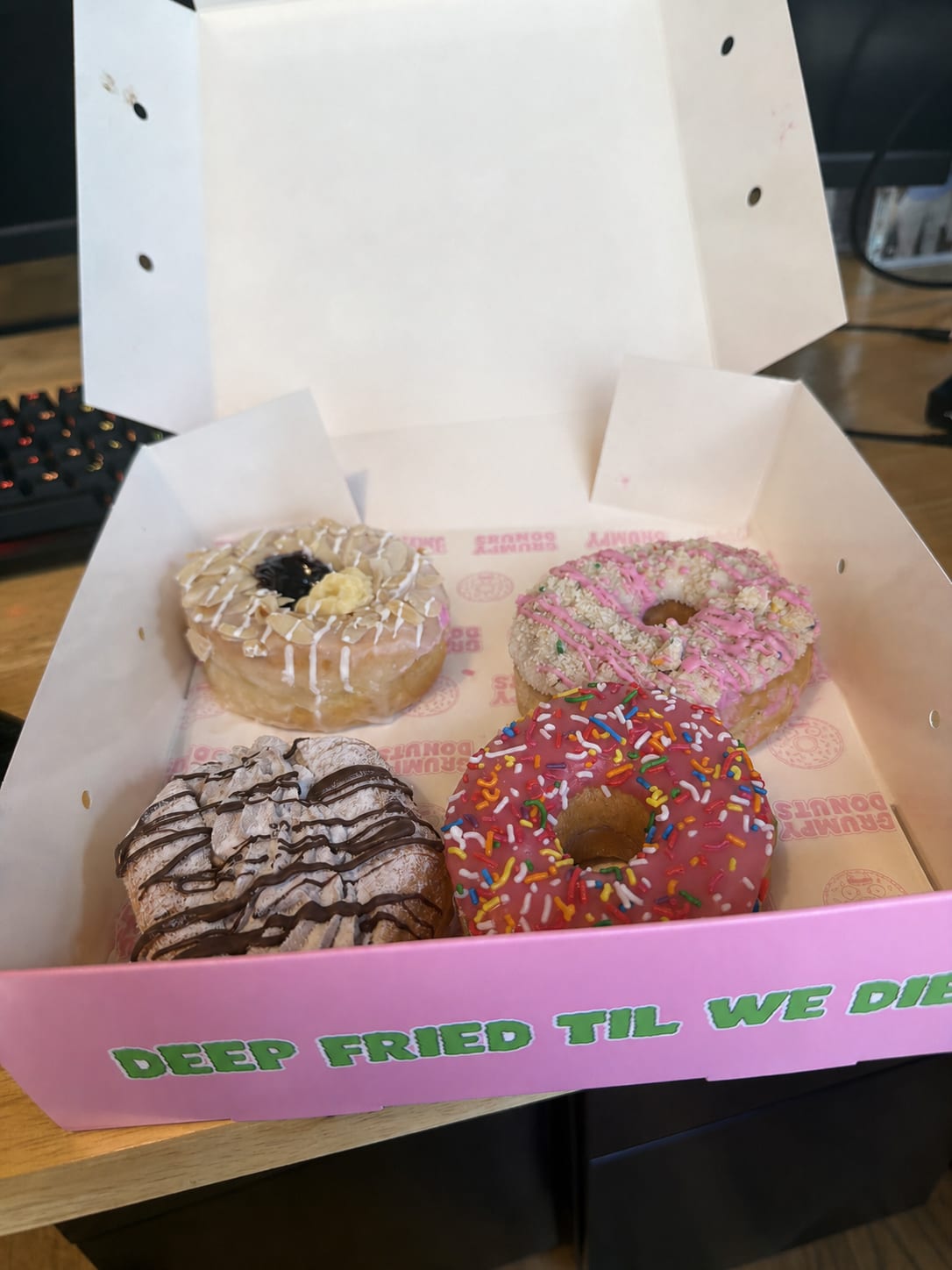
Pink sprinkle, strawberry crumb, chocolate drizzle, almond custard. Gone within the hour.
What I’m Taking Out of July
A few things, really.
Check the hunch. It’s easy to notice a pattern in a handful of memorable files and turn that into a confident statement about the market. Sometimes the data backs you up. Sometimes it backs you up but corrects your timing, which is what happened here. Either way you end up saying something truer.
Explain things properly and people arrive better prepared. That benefits them more than it benefits us.
Most of the friction in insurance isn’t in the advice, it’s in the admin around it. Forms, signatures, waiting on paperwork. None of that is the interesting part of the job, which is exactly why it’s worth fixing. And let me tell you, we have an internal list of probably 100+ items now to improve a lot of the mundane “admin” type tasks. Everyone wins!
Build the capability before the demand shows up, not after.
That’s July. If your business has picked up work in the US, or you’re in life sciences and your product is heading offshore, that territory clause is worth a look before your renewal comes around. Get in touch and we’ll go through it with you.
Marel Pencev Director and Principal Insurance Broker, Tank Insurance