
Contents
Ask what contract works insurance costs and you’ll get quoted ranges so wide they’re almost useless. So we did something different: we pulled a sample of 25 contract works placements from our own records from 2023 to 2026 and looked at what clients actually paid.
The key finding here is that the median contract works premium in our book was approximately $4,800. Behind that median is something very interesting: the cheapest quarter of our contract works clients paid around $3,400 or less, while the most expensive one in ten paid $20,600 or more - roughly six times as much. That’s the widest spread of any product in our book, and that spread is what this post is about.
How much does contract works insurance cost in Australia?
Across a sample of 25 contract works placements drawn from Tank Insurance’s records from 2023 to 2026, the median premium was approximately $4,800. Ranking all 25 premiums from lowest to highest: a quarter sat at or below approximately $3,400 (the 25th percentile), three-quarters sat at or below approximately $8,600 (the 75th percentile), and nine in ten sat at or below approximately $20,600 (the 90th percentile). These are observed figures from our own book, not market-wide rates, and project value, limits and risk size are not controlled for, so treat them as a reference point rather than a quote.
For a structured breakdown of pricing factors, our contract works insurance cost guide goes deeper. This post is the data companion: what the numbers from real placements look like, and why they land where they do.
What did the numbers actually look like?
Median approximately $4,800, with a p25 to p90 range of approximately $3,400 to $20,600. Here’s how contract works compares against the other lines in our book, using medians from the same 2023-2026 dataset:
| Product | Placements (n) | Observed median premium |
|---|---|---|
| Public Liability | 329 | ~$800 |
| Professional Indemnity | 301 | ~$1,700 |
| Business Pack | 374 | ~$2,800 |
| Contract Works | 25 | ~$4,800 |
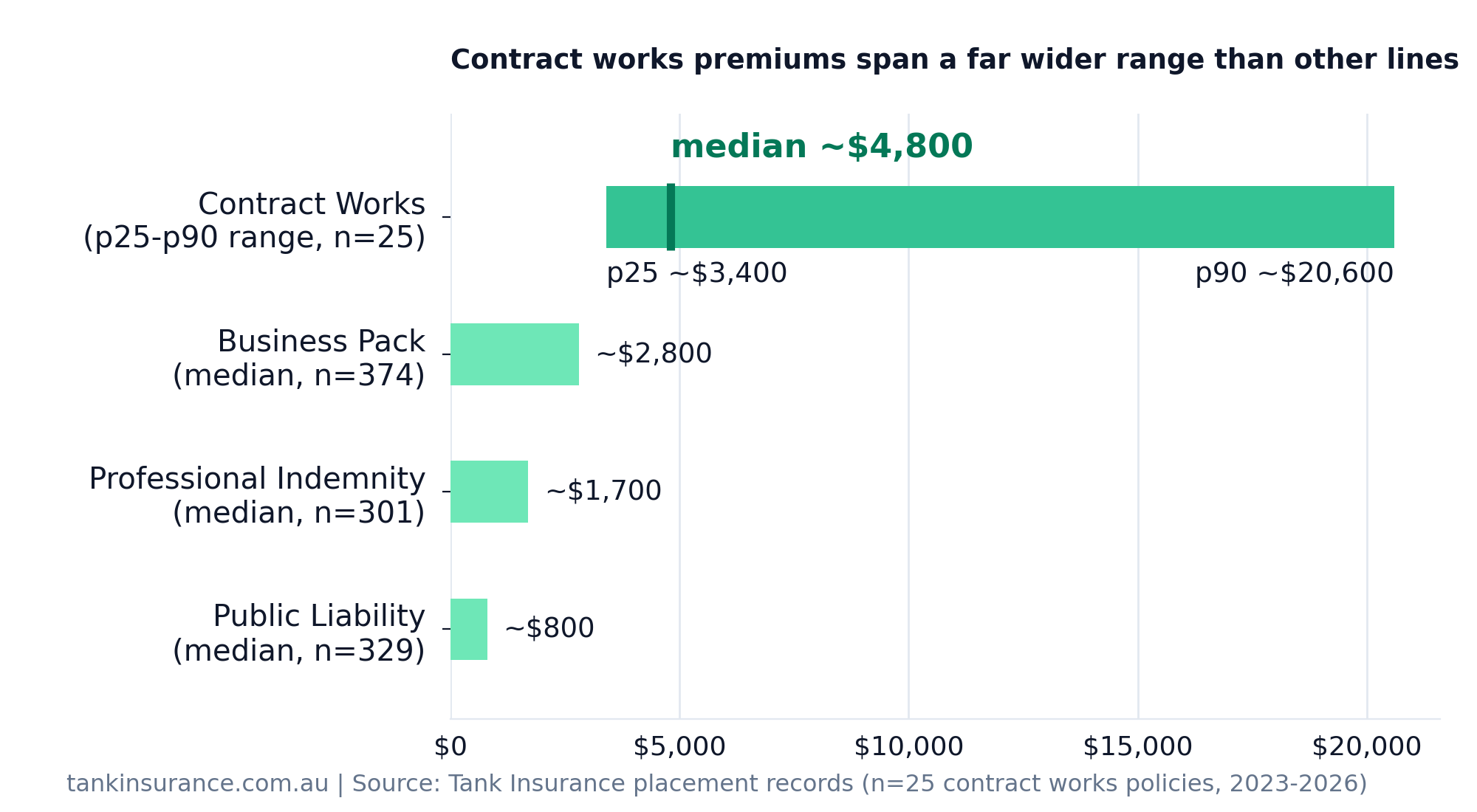
Source: Tank Insurance placement records, 2023-2026 (n=25). Figures are observed values from our book, not market-wide rates.
Two things stand out. First, contract works carries the highest median of the lot. Second, and more telling, the other products cluster around their medians in a way contract works doesn’t.
A quarter of our contract works clients paid under approximately $3,400. One in ten paid over approximately $20,600. Same product, wildly different price tags.
The caveats matter here. Twenty-five placements is a small sample compared to the 300+ we have for public liability or professional indemnity. Figures were rounded up to the nearest $100. And the policies span everything from modest renovations to substantial builds, so the spread partly reflects the variety of projects, not just pricing behaviour.
Why is the spread so wide?
Because contract works is priced on the project, not just the business. A public liability premium for a tradie is driven largely by trade and turnover. A contract works premium is driven by the specific job or programme of jobs, and projects vary enormously.
The big movers we see in practice:
- Project value. The sum insured is tied to the contract value plus margins for demolition, professional fees and escalation. A $300,000 renovation and a $4 million build are fundamentally different risks.
- Type and scope of works. Structural work, underpinning, work on sloping sites, and heritage buildings all attract closer underwriting than a cosmetic fit-out. The more of the existing structure you’re touching, the more questions get asked.
- Annual vs per-project structure. An annual policy covering a whole year’s programme of works naturally costs more in absolute terms than a single-project policy, even if it’s better value per job. Both sit in the same dataset, which stretches the range.
- Water damage exposure. Wet weather and escape-of-liquid damage during construction is a material rating factor, particularly for multi-storey work and projects with long periods where the structure is open to the elements.
- Location. Regional and flood-exposed sites can price differently to metro builds, and site location can limit which insurers will offer terms at all.
What do underwriters actually price on?
Contract value, type of works, builder experience, claims history, and project duration. That’s the core of every proposal form, and it’s where the premium is largely decided before any negotiation starts.
| Rating factor | What the underwriter is asking |
|---|---|
| Contract value | How much is at risk if the works are destroyed? |
| Type of works | New build, structural reno, or fit-out? How much demolition? |
| Experience | Has this builder completed projects of this size before? |
| Claims history | Any prior losses, especially water damage or storm? |
| Duration | How long are the works exposed, including defects liability period? |
Experience deserves a specific mention. A builder stepping up from $500,000 projects to a $3 million build is a harder conversation with underwriters than the contract value alone suggests. It’s not unplaceable, but it needs framing, which is part of why this is a high-touch line rather than a click-and-buy one.
Annual or per-project: which way does the pricing logic run?
Single-project policies price one job; annual policies typically price your whole year’s programme against a declared maximum project value. If you run one build a year, a per-project policy is the natural fit. If you’re running several concurrent or back-to-back jobs, an annual policy can work out cheaper per project and removes the administrative risk of starting a job uninsured.
There’s a structural pricing point worth understanding: on an annual policy, insurers typically rate your estimated annual turnover of works and your largest single project, then adjust at the end of the period. Structures vary between insurers, but the effect is that your premium scales with your programme rather than being renegotiated job by job. We’ve written a full comparison in our annual vs per-project contract works breakdown, and the annual contract works policies page covers how the declaration structure works.
One trap to avoid either way: cover should be in place before works commence. Arranging contract works insurance after work has started is possible but harder, because insurers want evidence of the condition of the works at the point cover begins.
What should you take from a 6x spread?
That a quoted “average” contract works premium tells you very little about what your project will cost to insure. The observed range in our book runs from approximately $3,400 to approximately $20,600 between the 25th and 90th percentiles, and both ends are real, placed policies for real projects.
The practical takeaway is to get your project priced on its own facts. That means a proposal that presents the contract value, scope, your track record, and site conditions properly, and a broker who knows which insurers have appetite for your type of works. Our contract works insurance hub covers what the policy does and doesn’t do, and the cost guide linked above walks through the pricing levers in more detail.
Frequently asked questions
Does contract works insurance cover projects that have already started?
It can be difficult. Insurers price contract works assuming they’re on risk from day one, so a build that’s already underway raises questions about the condition of the works and why cover wasn’t arranged earlier. It’s still placeable in many cases, but expect requests for evidence of the current state of the works, and sometimes an inspection, before terms are offered.
What does contract works insurance typically exclude?
Policies vary, but exclusions to check include defective design and workmanship (the cost of fixing the defect itself, as distinct from resulting damage), wear and tear, unexplained inventory shortage, and cessation of work beyond a stated period. Wet weather damage to unprotected works can also be restricted, which matters for structural builds with long exposed phases. Read the PDS closely rather than assuming.
Is an annual contract works policy cheaper than single-project cover?
It depends on your programme. A single-project policy is priced for one job, so for a one-off build it’s usually the logical route. An annual policy typically covers every project you start during the period up to a declared maximum project value, so if you run multiple jobs a year the per-project cost can work out lower, and you remove the administrative risk of starting a job uninsured.
How fast can contract works insurance be placed?
Straightforward risks, eg a residential build at a modest contract value with a clean history, can often be quoted within a few business days. Larger projects, structural renovations, or complications like works already started take longer because underwriters ask more questions. If a principal or financier is holding up your start date pending a certificate of currency, flag that up front.
Why do contract works premiums vary so much?
Because the policy is priced on the project, not just the business. Contract value, type of works, structural scope, duration, location and claims history all move the number. Two builders with similar turnover can pay very different premiums if one does cosmetic fit-outs and the other does structural renovations. In a sample of 25 placements drawn from our records, observed premiums ranged from approximately $3,400 at the 25th percentile to approximately $20,600 at the 90th.
Want your project priced on its own facts?
Send us the contract value, scope and start date and we’ll tell you honestly where it’s likely to land. Call 02 9000 1155, email [email protected], or get in touch through our contact page.